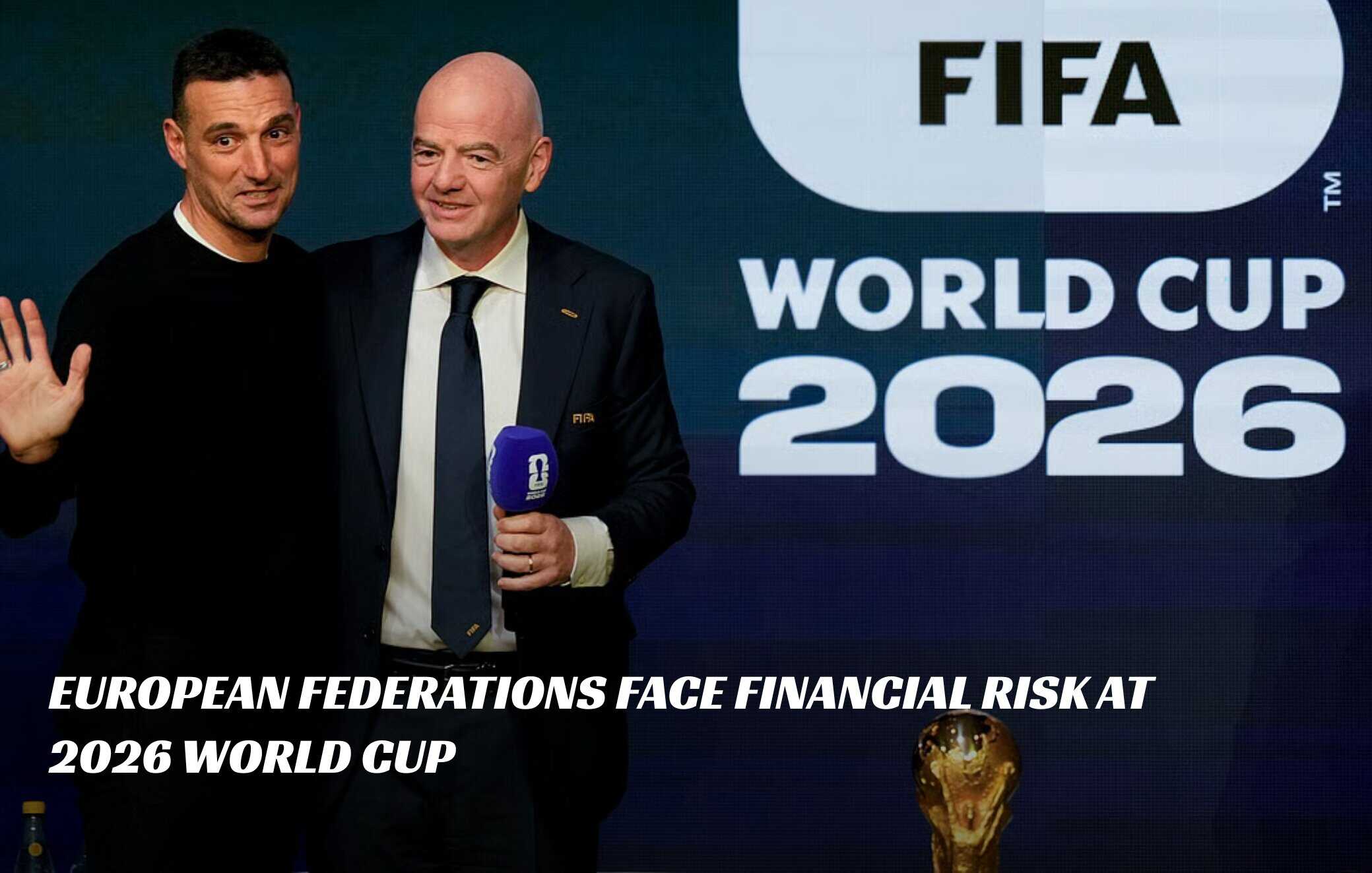
European Federations Face Financial Risk at 2026 World Cup
Several European football federations are increasingly concerned that participation in the expanded FIFA World Cup 2026 could result in financial losses rather than the traditional economic benefits associated with the tournament. Rising operational costs, reduced allowances, and inconsistent tax policies across host nations have created uncertainty, even as FIFA prepares to distribute record prize money.
Rising Costs and Reduced Financial Guarantees 2026 World Cup
Although FIFA approved a prize pool of £539 million for the 2026 tournament, the increased scale and duration of the competition have significantly altered the financial equation for participating federations. According to reporting from The Guardian and PA Media, federations that previously relied on World Cup participation as a stable source of revenue now anticipate narrower margins or outright losses.
Each qualifying federation will receive $9 million in participation fees and an additional $1.5 million to support preparation. However, the daily allowance per delegation member has been reduced from $850 to $600 compared to the previous tournament in Qatar in 2022. Over a full tournament cycle, one federation estimated this reduction alone could result in approximately $500,000 less in total support.
These financial pressures are amplified by the expanded format, which increases the number of teams and lengthens the tournament schedule. Federations must now support larger delegations for longer periods, increasing expenditures on accommodation, logistics, and staffing without proportional increases in financial compensation.
Tax Inequality Across Host Nations Creates Competitive Imbalance
Tax arrangements have emerged as one of the most contentious financial concerns. While host nations are typically required to provide tax exemptions to participating federations, such agreements have only been confirmed in Canada and Mexico. No equivalent nationwide exemption currently exists in the United States, creating uneven financial conditions depending on where teams are based.
This inconsistency is particularly significant due to varying state tax rates. For example, the top state tax rate in California, where matches will be played in Los Angeles and San Francisco, reaches 13.3%. In contrast, New Jersey, which will host the final at MetLife Stadium, has a top rate of 10.75%. These differences could result in materially different financial outcomes depending on team location and progression.
Federations have also expressed frustration that they have been left to independently navigate these complex tax environments rather than receiving centralized guidance or negotiated protections.
Extended Travel, Exchange Rates, and Tournament Scale Add Further Pressure
The geographical spread of the tournament across North America introduces substantial travel costs not present in more compact host nations. Teams may be required to travel thousands of kilometres between matches, increasing transportation, accommodation, and logistical expenses.
Exchange rate volatility has further compounded these challenges. Many federations operate primarily in euros or other currencies, and unfavourable exchange rates against the US dollar have increased the effective cost of participation.
The tournament’s extended timeline also contributes to higher operational costs. Unlike the 2022 World Cup, which lasted approximately four weeks from opening match to final, the 2026 edition will extend well beyond that timeframe, with 28 days passing before the quarter-finals begin. This prolongs the period during which federations must sustain full operational spending.
Concerns have reportedly been discussed among multiple federations, including during meetings connected to UEFA. For some associations, particularly those eliminated early, participation may no longer guarantee financial benefit. Instead, the tournament may represent a financial risk, challenging long-standing assumptions about the economic value of competing in the World Cup.
Written by 8JJ.com News Desk | February 26, 2026
Stay updated with 8JJ for Real-Time Sports Scores & Sports Related Updates
🔗 Visit our other platforms:
8jjSports.com